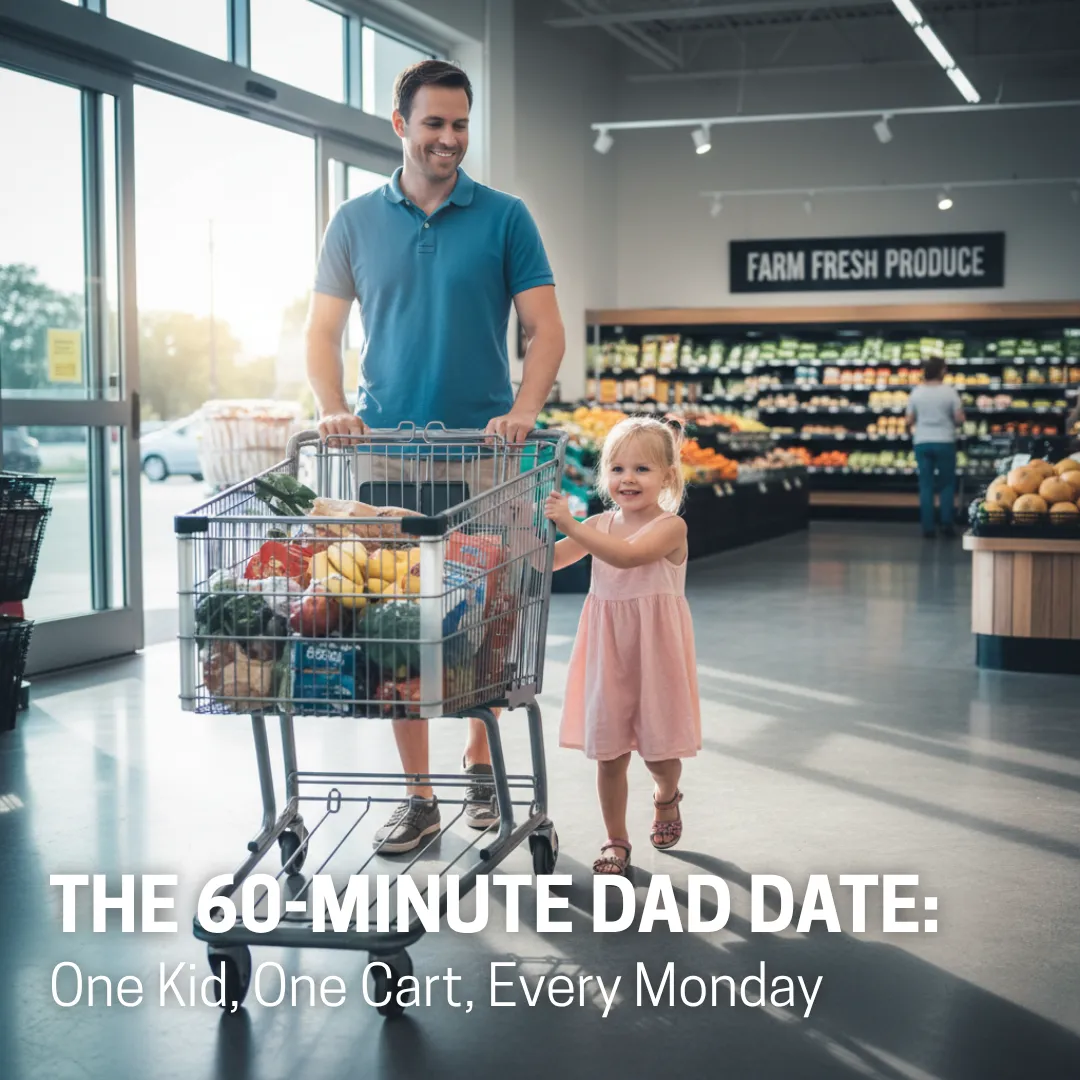
The 60-Minute Dad Date: One Kid, One Cart, Every Monday
The Heat in the Car, the Cold in the Store
By ten in the morning the car is an oven. We step through the gate after pickup, open the door, and that first wave of heat makes everyone laugh and squint. “Air-con soon,” I say, and we wait out the seat-belt sizzle and pull onto the road toward WalterMart. It isn’t glamorous. It’s groceries. But on Mondays that means one kid, one cart, and one steady hour that belongs to the child whose week it is. They know the rotation by heart—oldest, middle, youngest—and they ask about it days ahead, sometimes on a random Wednesday, sometimes on Sunday afternoon: “Is it my week?” The doors slide open when we arrive and the store breathes out cold air like a blessing. That contrast—hot drive, cool aisle—sets a simple stage where attention feels possible.
Why We Picked Ordinary on Purpose
This tradition started because the youngest was getting most of the one-on-one time by default. Toddlers pull gravity without trying. We wanted fairness we could sustain, so we tied connection to something we already do every Monday. No extra budget meeting. No reinventing the calendar. The grocery run gives us structure, a finish line (home by lunch), and a promise we can keep in every season. Even the timing helps—post-pickup, pre-lunch—when attention is still fresh. Ordinary is a gift to families; it repeats without asking for applause. The store gives us a place to walk slowly, to make small choices together, and to practice love in the shape of a cart.
Turning Off Work Before We Turn the Key
My wife and I are business partners, and the car has historically been our rolling conference room. If we’re not careful, strategy just hops in and rides along. So we moved the boundary earlier. If we need to talk business, we do it before we close the car doors on Mondays. Inside the car belongs to the child of the week. If a work thought bangs on the window, we say out loud, “Let’s park that for later,” and return to the voice in the back seat. Presence isn’t mysterious; it’s made of small decisions—phones face down, eyes up, a hand on a small shoulder at the crosswalk, and a willingness to let silence sit without rescuing it with chatter about tasks.
The Aisles, the Rituals, and the Little Flavors of Each Child
Every kid shows up differently. Our oldest (five) drifts toward beauty—a hair clip, a little bottle of nail polish, a tiny mirror moment in the makeup aisle where she asks for a picture and beams. Our middle child loves a mission, so the price checker becomes a miniature adventure—scan, beep, grin, repeat. Our youngest is kinetic joy; he runs small loops and then loops back for hugs like we’re base camp. We don’t carry a list of scripted questions; we carry curiosity that fits the moment. “Which apples look best?” “What was fun today?” “Who should we bring a surprise for?” It’s surprising how much connection grows when you trade quizzes for presence and let their answers wander a little.
Treats and the Shape of Generosity
We keep treats modest and repeatable—often a quick drink or snack, sometimes a Kinder Joy for the older two and a tiny chocolate for the youngest. The rule that teaches the most is the simplest: the shopper chooses for themselves and for the siblings at home. If it’s our daughter’s turn, she chooses for her brothers. If it’s one of the boys’ turn, he chooses for his sister and his little brother (with our help if it’s the youngest). “They like this,” they say, dropping something into the cart with a small nod. In that moment, “special” stops being a private benefit and becomes a shared story they get to carry home. Love turns into a package with someone else’s name on it.
The Child Who Isn’t Chosen This Week
Waiting is hard, even when your last turn was only a week ago. We don’t deny it or distract from it; we name it and frame it. Before we leave we ask, “What would you like us to bring back?” That question gives them a voice in an hour they’re not attending. When we return, we hand them the treat chosen in their honor and say, “We thought of you.” Over time, the sting of waiting loosens. The rhythm teaches that love takes turns and turns come back around. It’s a slow lesson with quick fruit: less tug-of-war over attention and more trust in how the family works.
A Real Conversation in the Car
Recently I asked our oldest if these one-on-one Mondays matter to her. She said yes in that small, sure way five-year-olds answer when they’re not trying to impress anyone. There wasn’t a theme song playing. No fireworks. Just a little truth placed in the space between us like a coin on a table: this matters. That’s how most of these hours feel. Not spectacular, but sturdy. You don’t notice the change in one afternoon; you notice it in the way bedtime softens, the way “Can I help?” shows up more often, and the way conflicts inside the house heal a little faster because connection was stored up earlier in the day.
When Real Life Tries to Cancel (It Doesn’t)
Some Mondays shove. A child asks for a second toy after we’ve already said yes to one. A budget line says, “Not this week.” The parking lot turns into a shallow river. We don’t pretend any of that is easy. We set the limit with a calm voice. We pray a short prayer of thanks for what we are still able to do: “Lord, thank You for this time. Help us be grateful.” If the rain is wild, we just move it to the next day. Our rule is stubborn in a kind way: the date can move, but it doesn’t vanish. Kids measure love with clocks and calendars, and reliability teaches them something sermons can’t.
Faith, Woven Quietly
Faith isn’t a speech we deliver aisle by aisle. It’s a breath we share. Before we head in, we often pray a short line—“Lord, help us be present.” Sometimes we pause to thank God for the food we’re allowed to buy. On the drive home, we pray again—just gratitude for the hour, for the silly treat, for the small joy that made someone smile. The kids join in, naming their own thanks in simple words. Dependence first. Gratitude last. It keeps us soft in the places that matter.
How an Hour Rewrites a Week
There are rarely fireworks. It’s more like a bend in the river you only notice because the current feels slower and kinder. On Mondays when we do the date, bedtime tends to land smoother. Sibling friction drops a notch. The house carries a low-level calm for the rest of the day that doesn’t come from a lecture—it comes from eye contact at a cart and a shared laugh near the apples. And on the days I’m thin on patience, that stored connection buys us time to pick better words. Leadership at home often looks like this: one faithful hour, repeated, until the culture of the house remembers it without thinking.
Make It Stick (Practical and Plain)
Put the rotation on the fridge so truth beats memory: oldest, middle, youngest, repeat. Tie the date to something you already do—groceries, library, car wash—so you don’t have to build a whole new habit. Set the boundary in the driveway: talk business before the key turns. Keep phones down; keep questions light. Let the shopper choose a gift for the ones waiting at home. When life shoves, shift a day. Protect the hour like it’s a tiny fence around your family’s garden. It is.
Quiet Challenge
Plan the next three Mondays now. Write the names, circle the time, and add two simple questions to a sticky note. Breathe this prayer before you go: “Lord, help us be present.” Then go buy apples—and connection.
Want plug-and-play rhythms like this without adding pressure? The Dad Mode Activated Jumpstart Bundle gives you simple, ready-to-use prompts and routines you can start this week. When you’re ready to build the longer system, the Five Pillars Alignment Course helps you stack habits that last.


